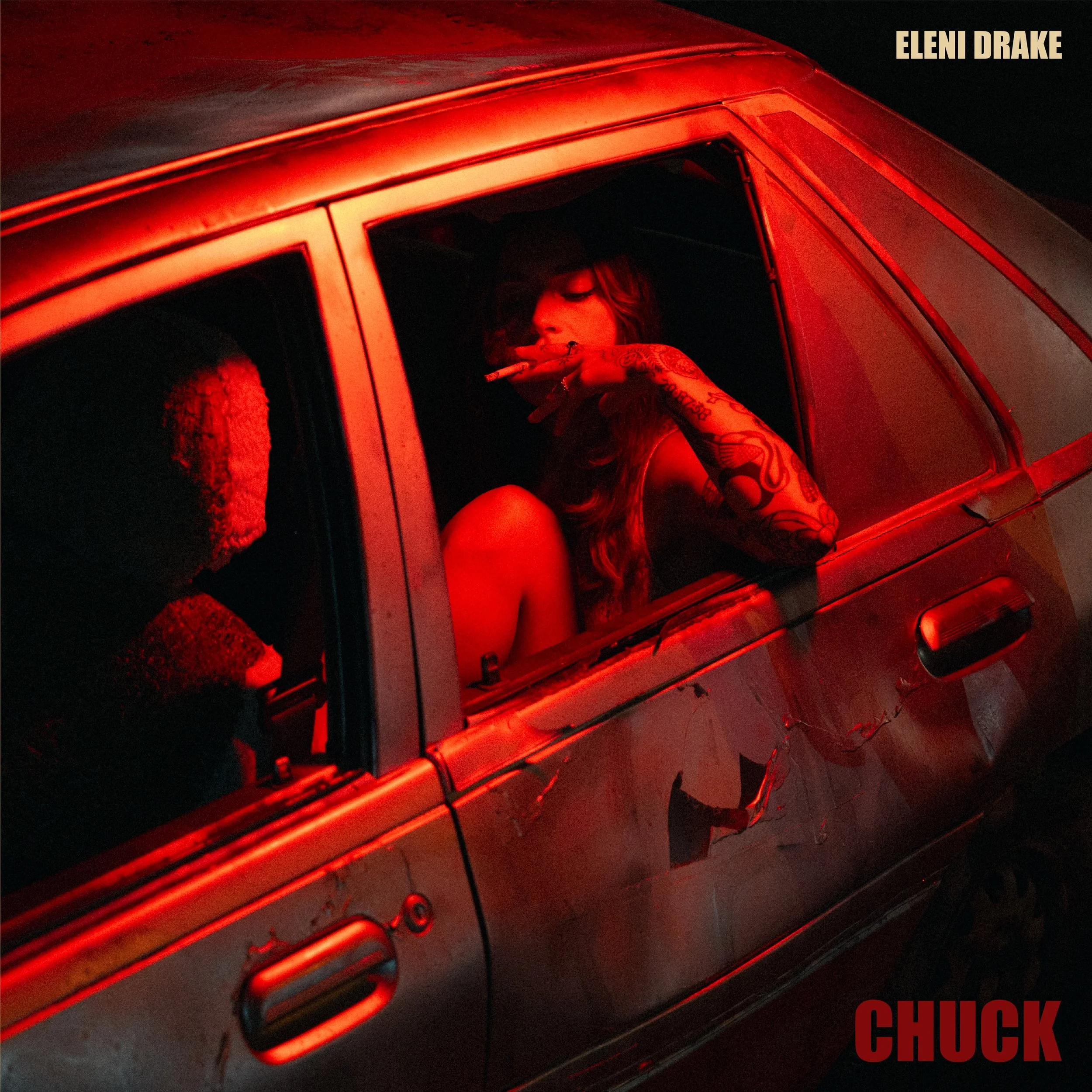

INTERVIEW: London’s Eleni Drake on her new album CHUCK: “I just want to feel things first … then I’ll write the songs”

Words: Emma Driver
Interview: Jett Tattersall
Published 3 December 2025
Eleni Drake, London-based songwriter, producer, singer and guitarist, has only just released her first album with a record label, but she’s a long way from being a music-producing novice. A West Londoner with British-Greek heritage, born in Johannesburg, Drake first appeared releasing songs on YouTube about seven years ago. Since 2019, she has been self-releasing her own work – three albums, an EP, and enough singles to develop and broaden her sound. Now her debut album with New York label MNRK has arrived, and if Drake hasn’t been on your radar before now, let the folk-pop-esque CHUCK be your introduction. You’ll find soulful songwriting that treads carefully across emotional hills and valleys, over a background of vintage acoustica, all delivered by a superb and nuanced voice. And there’s no way you’ll regret falling down this musical rabbit hole.
For an introductory taster, watch the perfectly captured live, outdoor versions of songs from CHUCK on Drake’s YouTube channel, featuring Drake accompanied by guitarist Sean Rogan and bass player Chris Rabbitts. On ‘Half Alive’, for instance, a delicate track from the album, Drake’s open-tuned guitar and a simple arrangement reveal the beauty of the song’s bones, and the performance is simple perfection. It’s clear she belongs there, in the middle of any stage, holding our attention.
As for CHUCK, it marked a big change in production for Drake: she tells us in the interview below that this was her first album recording in a studio instead of at home. Yet the musicians she chose to work with were friends who she’d played with in her live band, which is why the album feels cohesive and natural. And with Drake as co-producer, it stayed true to her vision.
‘A Wonder Day’ launches the album, a lilting optimism in its light guitar picking, simple strings and pedal steel guitar, then a delicate snare drum to lift the skipping rhythm. “I wanna have a wonder day with you” is the theme, a mini-imagining of a day sharing thoughts and dreams with a person who believes in you, who has stories to tell. It’s a little bit folk, a little bit country, a little acoustic storytelling. Drake’s voice moves with the emotions, shifting easily from spacey breathiness to an exacting kind of diction when she needs to, picking out syllables and shifting the weight of emphasis to carry her meaning.
Next is ‘Half Alive’, Drake playing electric guitar to open it, a hint of Phoebe Bridgers in the doubled vocal and arrangement, which layers up as the song winds along. Unhappy memories intrude – “I’m not here to burden my mind with the voices of you” – but the realisation that being “half alive inside your arms” means that breaking this connection was needed – and we get the feeling that this character might now live a fuller kind of life.
For a more uptempo experience, there are ‘Paper Moons’ and ‘Brockwell’, but beyond the mid-tempo drums and quicker pace, complications lurk in both, with lovers separated and hurting. (See the interview below for Drake’s inspiration for ‘Paper Moons’.) It’s a skill to superimpose sadness onto a chirpier backing, though on ‘Brockwell’ at least there’s the repetition of lines toward the end (“How can I not like the way you move?”) that close off on a happier note.
Complex relationships are excavated on songs like ‘Dolores’, ‘Leroy’ and ‘Alone’. ‘Dolores’, one of CHUCK’s singles, is a song in three parts: first comes simple, sunny love; second is the fracturing (“I’d do anything to leave”), flagged by a distorted piano line; and third is the recognition that “violent delights” have turbulent consequences: “It’d do me some good to remember this,” Drake sings. The knowledge that “all things must come to an end” is a big part of the album, Drake said on its release, and “embracing this truth without resistance” is all-important. Plus, she is big on “human experience”, as she tells us in the interview below, meaning that the less cheery aspects of life – like the dramatic aftermath of love she depicts in ‘Dolores’ – are necessary ones, too.
The pulse-like opening beat of standout track ‘Afterlife’ leads into ideas of life and death – “We’ll be strangers in the afterlife too.” Its country-style backing, with space to allow the plaintive strains of fiddle and pedal steel guitar, brings a lightness to the rich melancholy, while percussive taps on a saloon piano add to the sense of an old-timey bar. It’s a song of regret, and beautifully done.
Closing the album is a pair of short, mesmerising downtempo tracks. First, on ‘I Don’t Not Love You’, we learn why going back to a relationship that hasn’t worked out is rarely a good idea. “It didn’t end our way, and honey, that’s OK,” Drake reminds herself, as she looks to “fill the void” with someone else. A slow country pace with a buzz of distorted guitar is the ideal underlay here – it’s wistful, but the distortion hints at something darker, or things gone wrong. Then ‘Saw It Too’ meditates on a glimpse of the future with a partner that widens into a “kaleidoscopical view” of what could be. Memories and a possible future intertwine with present-day surviving: “I promise today / Don’t need to be better, just trust in fate.” Barely more than Drake’s voice and her picked guitar, with some backing for texture and harmony, the song is carefully paced and ends simply. Where will this character go next? Whatever happens, she’ll try to be gentle with those around her. “When you spend time in your mind / Just make it a place that’s always kind,” she tells her former lover in ‘I Don’t Not Love You’. It’s something that Drake says she thinks about, so it’s no accident that ideas of kindness are sprinkled through her songs.
All in all, CHUCK is an album that’s confident in its simple production because it’s so well made. And most of that comes from Drake herself, who is centred and strong in her musical identity. Beauty and kindness will always weave through our self-doubt and confusion, she seems to be telling us. It’s a message that resonates long after the last chord has rung out.
Women In Pop’s Jett Tattersall caught up with Eleni on the release of CHUCK, to find out more about her shift to the studio and her songwriting style.
Eleni, hello! So, massive congratulations on producing a cracker of an album with CHUCK.
Thank you very much.
Your previous releases were home-recorded, and now you’re with a label – MNRK in New York. And with that comes a studio. How did that shift in environment work for you on making this album? Did you have to make the studio more home-like, you know, with weird bits of home, certain smells, that kind of thing?
Well, yeah, we did actually burn some incense, because I love burning incense, but then we realised that there’s fire alarms absolutely everywhere, which is fair enough! So we were, like, “Let’s just put these in water.” There was no decor of mine in the studio, it was more that I’ve worked with these musicians before, and they’re some of my best friends, so it was very easy to go in there with them … Obviously, when you sign to a record label, you get an advance. And basically my advance just went straight into the studio, because I was like, “Right, may as well just make this count, and hopefully something good can come out of it.”
Those goal posts are consistently shifting, aren’t they? You might think, “Oh, I’ll put these songs out, I’ll get the label” – and then you get your label, and there’s another thing you have to do …
Yeah, it’s not as simple as “I’ve just got money in my pocket.” That money just goes instantly. But I just feel like investing in my own project – god, this sounds so business-orientated! [laughs] – investing in my own project may or may not work out, but hopefully it does. I was recording everything in my own bedroom before, and I just thought it felt more professional to actually go in a studio, as opposed to rock up in my bedroom and do everything by myself.
Your music is deliciously introspective – it comes from the very core. Did you think that this album have to sound different, because it wasn’t just you in your bedroom?
Not really. The musicians who played on it are the band that I perform with live. And when I would perform these songs live, I had this realisation that my band are ever so talented that they would just make my already-released and recorded songs sound so much better. And I was like, “What the fuck am I doing? Why am I not just getting these musicians to play on these things for me?” And that’s not to knock my younger self down – it’s just the truth. These musicians have dedicated their lives to working on their craft. And whilst I have as well, I would say I’m more of a songwriter than a musician, if that makes sense. These people are dedicated session musicians. So it was very easy to [decide to] get these guys in here. They know me. They get they get the music. They understand it. So when I showed them all the demos, they were like, “Right, got it. We’re on.”
You’ve described the album as both an ending and a beginning, which is very cool. It felt like a Snakes and Ladders board of a relationship – with the good times and the pitfalls. What made you decide to explore the endings particularly with such compassion and, at times, even some delightful self-deprecation?
Well, I think I’m growing up, I’m maturing, and not everything is always so black and white in my perspective [anymore]. And you know, when relationships end, it’s not always just one thing that’s happened – it could be an amalgamation of things. Basically, we all do right things in a relationship, and we can all do wrong things in a relationship – not heinous things, I’m talking about things not working out because you’re just not right for each other.
One of my previous partners is one of my best friends still to this day, and I kind of wanted to write about how beautiful I think they are, and how wonderful I think they are, and how they make me feel, as opposed to just kind of bashing them and saying negative things. It doesn’t have to be mean or cruel. Whilst I do think those songs are necessary – I love a little angry song, for sure – in my case, it wasn’t necessarily like that.
The album also isn’t just about one person. It’s about a couple of people, and it’s true that one of those situations didn’t end very nicely at all. But also I am human, and I understand that this is part of the human experience. So I can either move through my life with anger and hatred inside of myself, or I can move through it with a bit of grace, a bit of understanding and a bit of kindness, and just kind of go, “Hey, that was that didn’t work out. That was a bit shit, but it’s OK.”
To have that reflection about kindness, and to share that really means something, and it does something for other people who might be reassessing their own relationships. You’re doing a great service …
Thank you! [laughs] I’m glad you understood that, because I feel like I’m going about that in a wishy-washy way. There is a space for that anger and that rage and that “fuck you”, but the way I want to live my life is not necessarily through that, most of the time. So I just wanted it to be more of a “Thank you for your time. Let’s move on with our lives.”
Like, “Thank you for your service” …
Exactly! “Thank you for your service. The Google review is coming.” [laughs]
That’s great. So, let’s talk about tone and melody and production on CHUCK. One of my favourites is ‘Paper Moons’. That lyric “Let me sink beneath the blue” brings together the whole arrangement. There’s a shaking off of what’s going on. Can you talk about that one a little bit?
The way ‘Paper Moons’ sounds now is how I wrote it as a demo. I’m glad that it didn’t really shift much at all. It’s about external factors going on in my life at the time, and it wasn’t helping me to be in a relationship, because whatever was going on was taking up a lot of my time. And then I tried to explain that to this person, like, “Hey, I just need a minute.” But fortunately or unfortunately, they were really helpful in that process as well. I tried to end things with them, and I just kept on running back, because they would open up the door all the time. So I was in a cycle of, “This just isn’t this isn’t working. It isn’t good – but then it’s also great.” I wanted to feel happy, and I wanted to be better for them, but these external circumstances were out of my control.
When you’re tackling a song – and this is a very clichéd question – what is it that comes to you first? Is it lyrics, or do you start thinking of the moment and the melody comes first?
It would probably be lyrics. I usually sit with my guitar as I’m writing lyrics, so I’m simultaneously playing the chords whilst writing the lyrics, so I know that it kind of makes sense. So it’s both the guitar and lyrics, and I’m humming a melody with it.
Do you ever surprise yourself that you’ve got, like, a pretty bop with some crushing lyrics, or the other way around?
Yeah, I feel like there’s something to be said for a sad song that is masked behind what seems to be a little bit more happy and cheerful. I’ve noticed that so many people don’t really listen to lyrics. Like, there’ll be a song that I’m listening to – not my own song – and someone will be like, “That’s a great song. It’s so happy, it’s cheerful.” I’m like, “Have you heard how devastating it is?” and they’re like, “Nah …” So I think that’s a great way to mask what might not be a very happy song – get some major chords in there, and people think it’s a happy tune.
With this album, and your music in general, you lean into mythology and pop-culture references. I know that “Chuck” is a nod to the character in Pushing Daisies [2000s TV series], and ‘Dolores’ is inspired by the character from Westworld. Has that always been part of your songwriting? Do you absorb fiction and then create scenes in your head?
No, actually I don’t! And I don’t watch that much TV. I wish I did. So what I do watch kind of stays with me. But I’m glad you said I referenced some pop culture, because I don’t think I ever do, so that’s cool. [laughs]
I guess I just don’t really think much when I’m making music. I tend to not write about something when it’s happening, because I’d rather live it like a human being, rather than constantly be putting my music first. I just want to feel the things first and go through that normal human experience, whether it’s great or bad stuff, and then, after I’ve digested whatever’s happened, that’s when I’ll write the songs. Typically, then, they’ll naturally flow out of me. I don’t think I play scenes in my head, though. I wish I could. That would actually be quite a cool way to make music.
Has songwriting always been for you a way to process relationships and interactions? And not just romantic relationships?
Yeah, for sure. I remember writing lyrics when I was as young as eight years old – horrendous, by the way, absolutely abysmal. What am I grieving about at eight years old? But from a young age, I just felt like it was a “dear diary” to myself. And then I just thought, one day, “Hey, let me share my diary with the world.” [laughs]
Were there songs for CHUCK that didn’t make the cut? Are there some that you wish you’d written about, or others that you just couldn’t write about?
Actually, in a very weird turn of events, I had written twelve songs for this album, and they were the exact twelve songs that had made the album. I didn’t write any more. I didn’t write any less. So it was quite weird – that’s just what it was.
What do you feel is the next avenue or curiosity you’re keen to scratch and chase musically?
I’ve been playing with the idea of just going under a different name, and making music that I would never have thought of releasing. I just want to experiment with a few other things, because I used to make lo-fi jazz music, and then I realised that’s not necessarily the music I want to be making full time. So I gravitated towards the music I make now. But I think I have put myself in a bit of a box, and I am just a bit of a scaredy cat. So I think I just want to try a few different things.
Well, we look forward to your death metal album, whatever pseudonym that comes under …
[laughs] If it’s gonna be death metal, heavy metal or, you know, something ethereal, we’ll see …
Thank you very much for your time Eleni, and for such a ridiculously gorgeous collection of songs. And enjoy all the fun that comes with it.
Thank you so very much, and thank you for your time!
Eleni Drake’s album CHUCK is out now. You can download and stream here.
Follow Eleni on Bandcamp, Instagram, YouTube and TikTok