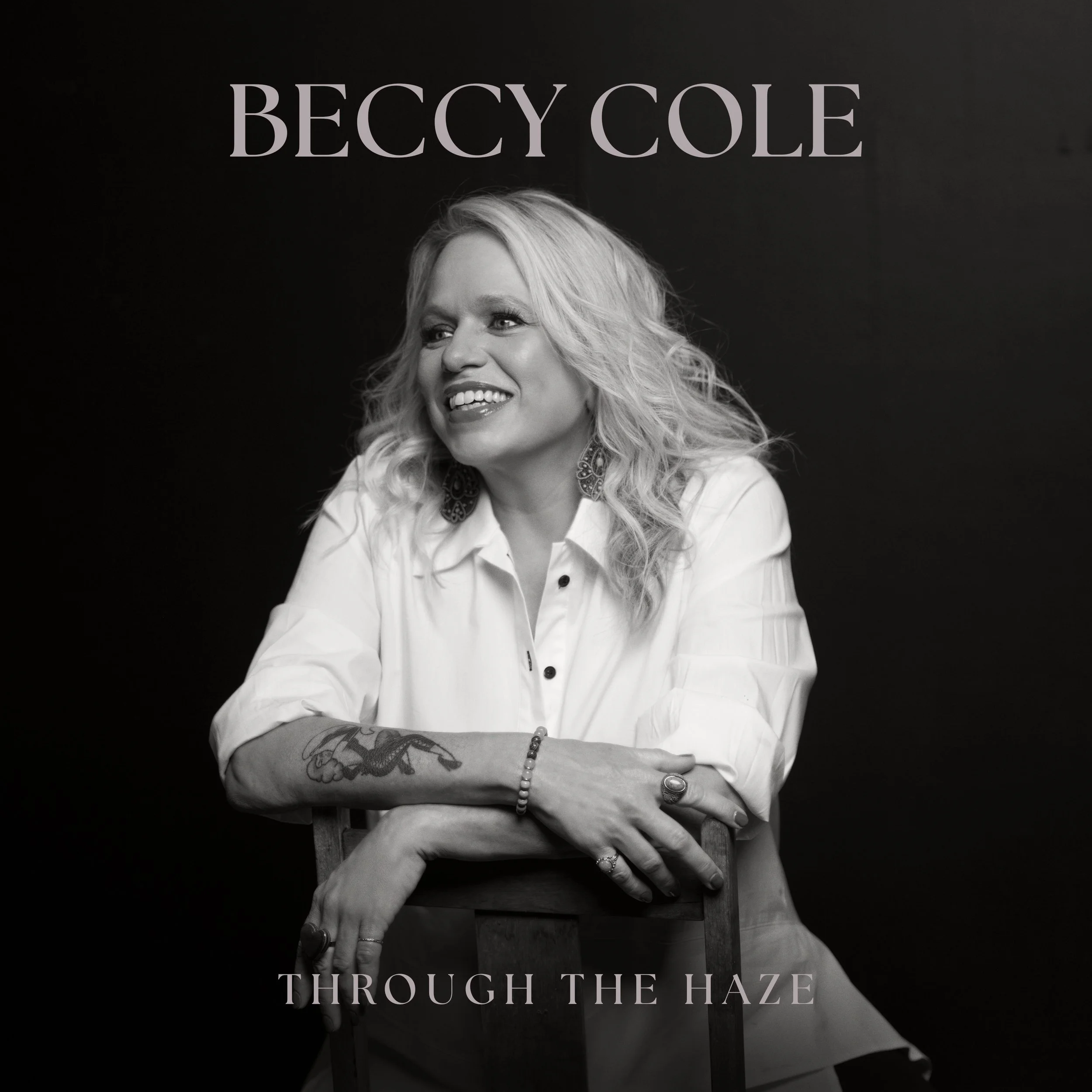
INTERVIEW: Beccy Cole on her new album 'Through The Haze': "I'm less frightened about being vulnerable...But there's another level of vulnerability that comes with having an actual breakdown."
Words: Jett Tattersall
Interview: Shalane Connors
Image: Duncan Toombs
Published: 13 March 2026
Diaries exist to say the things we couldn’t say out loud. When we leaf back through them, they’re a reminder of a perspective skewed by hurt, by being blindsided, by being hopeful and wrong. But when a diary becomes an album, the confession becomes communal. With any airs, graces and second-guessing stripped away, it becomes a place that says: “Hell, me too.”
Today, country music matriarch Beccy Cole releases Through The Haze - her ninth studio album and her first in seven years. Produced by Brandon Dodd and featuring her band, The Sisters of Twang, it is a fresh wound record. While the songs were forged over four tumultuous years of heartache, the recording was over in a heartbeat. Trusting her instincts and comfortable in her execution, she chose to bottle those years of experience into a lightning-fast, two-day session. It’s the sound of the penny finally dropping - that split second the haze clears, you see a situation for what it is, and you quickly scrawl it into your diary before the feeling fades. That atmosphere is palpable in the listening; we hear each knock, smile, toe tap and breath. It’s quite something. As Cole recalls, “There were no egos, no hidden agendas, just a group of mates making music and having the best time.”
As the title suggests, the album covers heavy ground - from breakups to alcohol addiction - written as Cole navigated a series of unfortunate events and people. Yet, in the opening guffaw of ‘Shit Magnet,’ an ode to her disastrous romantic choices, Cole finds the humanity in the wreckage. There is warmth and humour here; it’s not just finding light in the dark, but a sardonic giggle in a pileup of bad decisions.
One of the record’s most affecting moments is ‘Faded Star,’ written while Cole was in a recovery facility at her lowest ebb. It’s a steely, "last drinks on the lost highway" kind of song that captures the hollow ache of addiction. As Cole puts it, “Misery and melody go hand in hand when harmony is gone.”
That same sense of hard-earned perspective carries into ‘I See You Now.’ Here, Cole turns her attention to the kind of toxic dynamic many people know all too well. Inspired by the bite of Olivia Rodrigo’s ‘Vampire,’ she sings: “I gave you my spotlight, and you gave me your gaslight.” It’s a sharp line, and one that lands with the force of someone finally seeing the situation clearly.
But Through The Haze is as much a riot as it is a reckoning.
‘Porcupine’ plays like a girl-group bar-brawl instigator, while the high-octane ‘Shovel’ is a grin-inducing beast of a track. Finally, a 20th-anniversary re-recording of ‘Poster Girl’ closes the loop - a nod to the long road behind her, sitting comfortably beside the unfiltered honesty of the present.
In the end, Through The Haze feels less like a grand statement and more like someone flipping open a diary and reading you the good bits - love, loss, chaos, and all.
Hi Beccy, congratulations on your ninth studio album Through The Haze. It's been a long time coming, how are you feeling?
It's a bit surreal, to be honest, because even though there's been a really big gap between recordings, the actual coming together of the album has been really quick. I went to the studio in two stabs, and the last one was only in October when we recorded the last half of the album, and that wasn't that long ago. So it’s been a really quick process from finishing the album to go ‘let's get this out here’. I actually wanted to put it out earlier, but it's a process!
I had such a great time listening to the album, it really takes you on such a roller coaster. It covers a lot of quite heavy subject matter, from breakups to breakdowns to alcohol addiction. But I laughed out loud so many times because you touch on these subjects with such humour. Talk to me about that approach, and the idea of music as therapy for you.
You're right, the album's a roller coaster, and it is a definite reflection. I always have found that songwriting and songs are a bit of a snapshot in time, they're a bit like a diary entry. And this album was always going to, in some way, cover a major break up and a subsequent breakdown. But I don't think it's the full focus of the album, there's a lot of that there I guess, but it's just the block of time between my last album and this one, and the things that I've learned and gone through and major events like a divorce, are going to get covered. I've already had a divorce album, this is my second divorce! There's other subjects that are covered on the record, but it's probably my most honest. I'm a little bit like Chandler from Friends, when it gets too real, I get funny! So there's an element of that humour on the record as well.
Do you feel a high level of vulnerability putting these songs out into the world?
I do, but I'm less frightened about being vulnerable, and I think that's from years of songwriting. I probably felt my most vulnerable in 2011 putting out Songs & Pictures, because that was my first time ever writing 100% my own music and I really tapped into a lot of stories, so I feel like I've already broken that seal. But there's another level of vulnerability that comes with having an actual breakdown, where your mind's threatening to leave you. I've been through that, and I had never been suicidal or anything like that before, so there's that vulnerability, but I probably hadn't thought about it till you pointed it out.
Did songwriting help you get through those moments?
Oh, yeah, it's very therapeutic, and it's free therapy. I've been involved now in so many different forms of therapy and art therapy is massive in that world, I was in a facility for a little while, and one of the therapies that I went to was music therapy. And [the therapist] just said, ‘I don't know what to do with you [because] I'd normally write a song’. And I said, well, that's the one thing I can't do because I had lost my voice as well,
I kept just trying to write a song about what I was going through, which I have obviously been able to do now that the album's out, but at the time, he suggested to me that maybe you need to write about someone else, write about another subject. And I think that's how I got back to me, by writing. I didn't think I was worthy even of writing a trashy song about myself, so I started observing and writing about other people, and I think that's what got me back on track.
You've been in the industry a long time, over 30 years. I'd love to know what you've kind of seen or felt change in that time in terms of women in the industry and queer women in the industry in particular.
Well, firstly, being queer, I think the acceptance is certainly there. It possibly was always there. It was just a societal thing that made us frightened and worried about what may or may not happen. I hid my sexuality for many years. I realised I was gay at the end of the 90s, and I didn't come out publicly until 2012. So period was one of fear. Everyone close to me knew that I was gay, but in terms of acceptance and marriage equality and things like that, there's a few things going on in the world that makes us feel like things are going backwards, but acceptance as a whole has improved. I touch on that on one of the songs, actually, even though it's a comedy song, ‘More Cows Than Cow Girls’ I talk about ‘I don't miss keeping all that hidden’. And generally that's how I feel. It's still hurts when you come across homophobia, but it's become a shock to come across homophobia, whereas it used to be the other way around I suppose. You get acceptance where you didn't think you would, and then all of a sudden you're feeling great. Now when you come across someone who's homophobic, you go, wow, that is so old and antiquated and often fear based itself.
Yeah, you almost feel sorry for them.
Yeah, you do, you do. And in terms of women, we're still fighting for positions on festivals, and in my job on radio, that I've just left actually, I would be promoting festivals, and it's still the main three headliners are blokes. And about six rows down, you start getting the women on the billing. Also on the charts, we follow America in so many ways, within this genre especially, and the blokes, absolutely dominate the Billboard charts. Therefore, when you get someone like Lainey Wilson or Ella Langley that comes along in country music, that dominates on the chart, in amongst one bloke having 11 positions, and you get one woman, and we go, yay, there’s a girl on there!
So there is still that, and also equal pay. The statistics just came out in general for women still not getting equal pay in major corporate positions, and music is a lot like that as well, but we battle on. I've seen improvements, and the fact that there’s capacity for longevity within country music, especially in this country, with the loyalty of the fans. I enjoy that wave, so I'm lucky with that.
I'd love to talk about the recording process of this album. You mentioned that you made this album with a bunch of mates. How was the energy in the room, and how did that affect the way that this album was created opposed to your previous ones?
Definitely my most favourite album to record, and I deliberately surrounded myself with all my favourite people including my band, The Sisters of Twang. There's no one producer on this record, we all made an equal contribution, so I couldn't really single anyone out. It was my son's idea, he said, ‘where do you want to make the record?’ And I said, somewhere safe, I needed to take these songs to somewhere that I was going to feel safe. He said, ‘What about your best friend's house? Kasey Chambers has a studio’. I had never even thought about it and it was just so relaxed. Jeff McCormack engineered and mastered the record, and he's played on just about all of my records from back in the 90s, he's part of Kasey Chambers’s band as well. He's just one of the best people in the industry, and I always feel comfortable doing vocals around him.
We were sitting there one day, and we realised we had people in their 20s and 30s and 40s and 50s and 60s on the record, we had somebody from each decade, and it was kind of a cool thing.
Just having that safety around you, especially after being in such a delicate state for so long, and wanting to get my art out there, and to use a vehicle to get it out there that I felt comfortable with. The process was just my favourite and I'd be very surprised if I didn't make another record exactly like that in the future.
You're a self confessed gig pig. What does it mean to you as an artist to be on the road, performing to your fans, meeting people?
It gets a bit crazy when I'm not on the road, and I've learned a little bit more to have some time off from it. I think covid taught us all that because up until then, I think the biggest break I'd ever had from touring or doing gigs was way back when I was eight and a half months pregnant with my son, who turned 27 yesterday. I stopped, and then I took a two week old on the road. So up until covid, you look at your diary and you go, oh, in three months time, there's a weekend off. I better fill that. I never looked at scheduling weekends off. It just wasn't in my DNA, even from a kid. I did gigs on the weekend from when I was 14 in my mum's band.
I love playing live, and I get excited about it. And I love that after three and a half decades on the road, I still get excited about a gig, no matter what it is, no matter what capacity. Obviously, we love playing festivals and big stages, but there's something special about an intimate gig too, playing to 100 people in a small room.
Is there a gig that you look back on and you go, wow, that was the peak, that was something I never thought I'd be able to do?
There are moments more than gigs. Singing in the middle of the the MCG and things like that, that happened years ago, but in terms of where I'm at now, playing the Gympie Muster stage is probably the pinnacle these days. And the last few times I’ve done it, I've thought it won't be like this again. I'm not being ageist against myself, but it just is what it is. You've got to make room for other people. But they still rate heritage acts there, which I am, and so there's enough room for the new, up and coming, amazing thing, and for us to sit on the hill and watch somebody who's been around for a long time. That's why I called the album Through The Haze, because in the song ‘Sober’, I say, ‘I could see you through the haze’. When I was at my lowest, what I was trying to think about the things that made me happy, and I thought about that crowd at Gympie. It was picturing the crowd, it seems like I might be thinking about one person, but it was the whole crowd. And so that's one of the motivations that got me through.
I know this is an impossible question, it's a bit like asking you to choose a child, but if there was one track on the album that you're the most proud of or that you think is the most reflective of Beccy Cole, which would it be?
Oh, that's interesting. It probably depends on what day day you ask me, but today, I think maybe ‘The Gardener and The Flower’, because it's sort of proof that I do understand love, even though it hasn't worked for me. I really enjoyed writing that song. It wrote itself really, really quickly, and I think that it's a breath of fresh air on a record that has a lot of cynicism and bitterness at times, and I really enjoy doing it live. It's like a little island on the album.
Do you have a favourite line from the album? I'll tell you mine: ‘I wish you well. Elizabeth, on the other hand, fuck you’. That is the best opening line of a song ever!
Funny that you should say that, because when Matt Fell was mixing the album he texted me that and said, ‘What an opener!’ It's straight to the point, isn't it? There's a lot of things that probably come with age where you get straight to the point. I needed the humour on that song and on a couple of the other ones as well. I needed that humour, that was part of my therapy, to laugh at what I went through.
I wrote the song ‘I See You Now’ and one of the first lines I thought of was ‘I gave you my spotlight and you gave me your gaslight’. That line was going through my head for ages before the rest of the song was built around it, that's the only co-write on the on the album as well.
I did enjoy the writing process. I'm really good with a deadline, my art works better when I've got a deadline. If I've got all the time in the world, it doesn't seem to come out of me. Even when I had booked the second session, I was about six weeks out, and I think I had one song and I needed six for the for the next session. I'm not one of these prolific writers that has 50 songs to choose from. In fact, I needed six songs, and I went in with five. We had an extra day recording that we were going to cancel. I said, can I cancel in the morning? I'll see if I write one tonight. I didn't write one that night, and the next morning I got up at five and I wrote, I think it was ‘Happiness In Your Hands and we went into the studio and recorded that the next morning.
What's coming up for you next? The album is out, do you have a tour as well?
Yeah, we're doing some launches in May in New South Wales, and I'm touring for most of the year. We're just putting together the tour at the moment. I just gave up my job at ABC Radio, I was doing that for five years, but it was time for a new, fresh start with new music. I have absolutely loved listening to other people's music for the last five years, it's just got me into a completely different zone, and it's really helped my creativeness and also just remaining curious about other people's music. The best thing you can do for your own music is becoming and remaining a fan and being a champion for other people. To be someone else's cheer squad and not be so caught up in your own ego, being safe in that space too, not having jealousy and all that kind of stuff. So radio has definitely expanded that in me over the years.
Who are you loving at the moment?
Oh gosh, there's so many. I recently saw Gillian Welch and David Rawlings, it renewed my love for Gillian Welch. I’m listening to Sierra Ferrell, I absolutely love her. I actually wrote ‘Elizabeth’ after I went and saw her in Sydney at the Enmore, and that driving bluegrass thing in there I think I was motivated by her.
Through The Haze is out now via ABC Music. You can buy and download here.
Follow Beccy Cole on Instagram, Facebook and her website