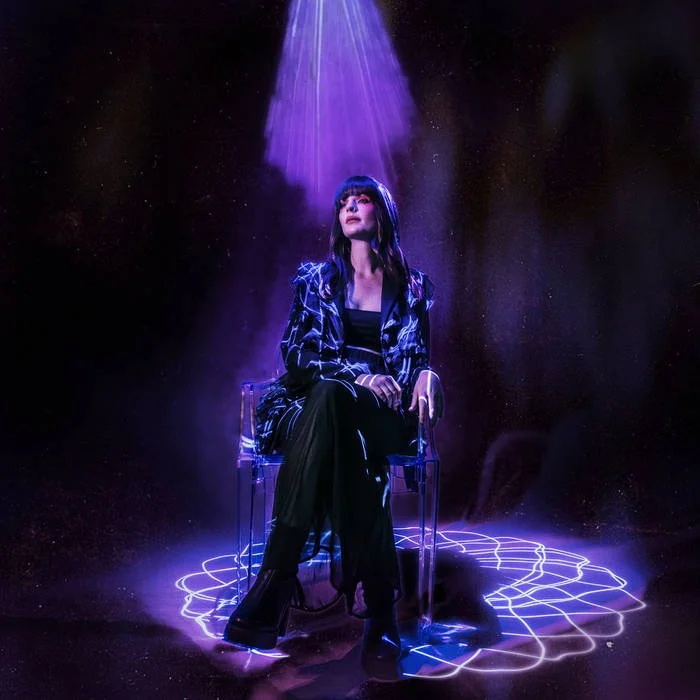
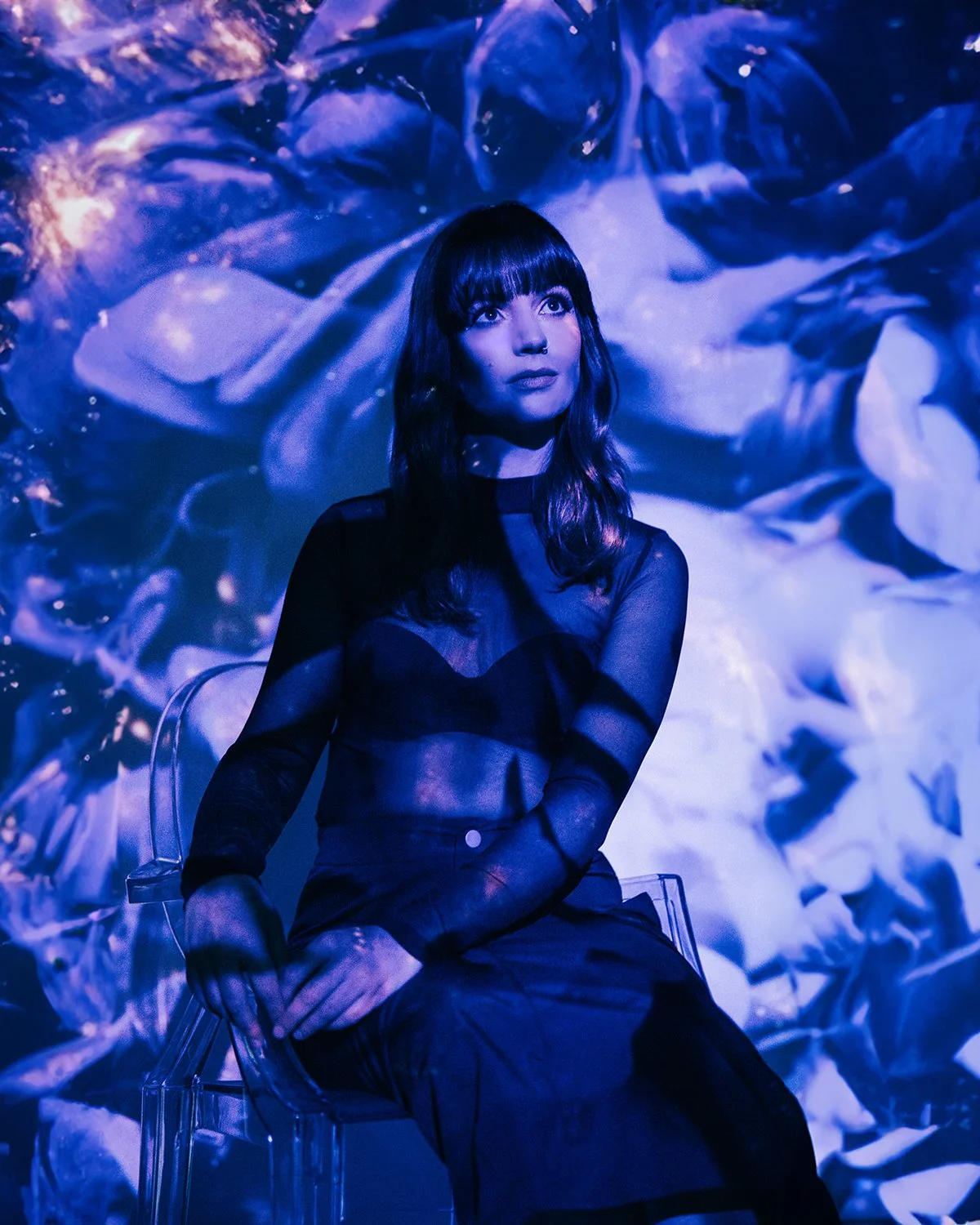
INTERVIEW: Anna Smyrk on her debut album 'Spectacular Denial': "I'm able to use the songs to create a space for people to feel things, which is what I'm trying to do when I make music"
Words: Jett Tattersall
Interview: Shalane Connors
Image: Michelle Grace Hunder
Published 30 April 2026
We’re taught to chase clarity; it grounds us, levels the field, and gives us something firm to argue from. But sometimes there’s a quiet kindness in letting things drift… numb… and blur.
Following the sudden loss of her father - her “first and biggest” fan - independent music-maker Anna Smyrk describes a period of disorienting numbness.
“Denial and staying numb can be a useful part of the process”, she reflects. “It can protect you when you’re not ready to feel your feelings.”
Framing it as a kind of practice run for rejoining the world. Life observed from behind a velvet curtain, sheltered inside a space of her own making.
Smyrk’s debut LP, Spectacular Denial, explores numbness as a form of survival - a pause that allows space for healing. Across the record, she turns toward the strange usefulness of disconnection, tracing how we construct shelter before we’re ready to face what comes next.
“The album doesn’t move in a straight line from grief to acceptance,” she says. “That has not been my experience at all.”
Instead, it arrives as something messier and raw. Moving from the shock of loss toward a fragile resolve to stay open… even when that means holding crippling grief and hilarious joy in the same melodic breath.
Much of Spectacular Denial was written, unintentionally, in scrawled notes and private processing. Snippets and windows into herself. Smyrk later returned to them when she could recognise herself in the fragments again. The songs slowly took shape over several years before being recorded live with her band in late 2024. That intimacy and visceral chaos linger in the grooves of the record.
The album’s opener, ‘Skin Thinner’, in all its cool, confident delivery, lands as the first shock - everything suddenly feels slightly out of reach. There’s an instinct to stay sealed off, to keep a layer in place, and you can feel her starting to push against it. ‘This Is a Drill’ carries that unease forward. Denial turns strange. Every day life carries on, just… at a distance. As if it’s all happening somewhere just off to the side.
By contrast, ‘The Future Conditional’ drags the record across the floor into a sharper place, creating a striking shift. All drive, distortion and teeth. From the opening bars, it’s clear why it’s Smyrk’s favourite to play live. Beneath that chaotic swell of amps and guitars, under the unstable beat, sits a quieter undercurrent: a preoccupation with what could have been.
‘Garden-Variety Grief’ turns outward, finding loss in the small, ridiculously ordinary persistence of life when something huge is sitting underneath it all. “Grief is so isolating,” Smyrk notes, “and somehow, we’re all still getting up every day, making jokes, chatting to mates, doing our laundry, just living lives.”
That almost involuntary grin comes from recognition - that grief, though deeply private, is something almost everyone is quietly living alongside.
Which is what makes Spectacular Denial feel so exact as a title. Avoidance as a protector, a spectacular state. Vivid, loud and temporary. A way of staying open just long enough to “hold the painful stuff and the joyful stuff at the same time.”
Hi Anna! Congratulations on your debut album, Spectacular Denial. How does it feel to finally have a an LP out there?
Thank you! It feels really good. It's been such a long time coming, this is the first time I've done a full length album. It's felt like it's been a real marathon putting it together, from writing the songs over several years to then actually recording it in late 2024. I’ve been sitting on it for a while, so I was very ready to release it. It's lovely to have it out there and get some feedback from the world, because you make this thing by yourself behind closed doors, and now it's opening it up and seeing what people think of it, which is cool.
You created much of this album in the wake of losing your father unexpectedly. I wanted to ask you about the process of turning grief into art and what effect that's had on you?
I sort of felt like it was inevitable that I was going to write songs about grief after my dad passed away. I usually just write songs about whatever's happening in my life, it's the way that I process the world.
I actually didn't write for quite a while after he died, I just found that I didn't have the words to express what was happening. When I did start to write, what was coming out was all these songs about not really being ready to feel my feelings, which is where this record about denial came from.
The process of drawing on grief to make art has been a really interesting one for me. It's definitely been a big part of how I've processed the grief. The way I write songs is that I will have a thought or a reflection or an idea, and I'll write it down, I'll make a note of it, and then I'll come back to it later and try to flesh it out and tease it and reflect and see what's happening there. That sort of practice was really useful for me as I was, and still am, navigating the loss of my dad. I was going through all these big, big emotions, lots of new thoughts, lots of new feelings, and being able to have this practice of reflecting and writing stuff down and trying to find ways to express what I was feeling and what was happening to me was really useful.
The other part of that is trying to share that and get it out in the world, and what I've found as I've been playing these songs and sharing these songs, is that almost everybody has a loss that they've been through in their life. It's a universal human experience, whether it's the death of somebody close to you, or the loss of a relationship or a friendship, or some other big rupture in our lives that we might be grieving. There's something about sharing art from that place that creates a connection in a way that is really tangible and feels quite important.
Touching on connection, you've just recently embarked on a community garden tour across Victoria. What led you to the decision to do that, and how important is community for you in your music career?
The idea came about when I was thinking about releasing this music, and I did want to find a way of doing things a little bit differently for this release because of the nature of the songs and the subject matter. I wanted to make sure that I was doing it in a way that felt really connective and nourishing, I guess. I was thinking about how I wanted to do that, the things that have gotten me through difficult times, and the three things that came to mind were community, music and nature. So I decided to do a tour of community gardens, there's been about 20 odd shows all around Australia in different community gardens, from really tiny grassroots ones to quite large established organisations that have been going for decades. It's been such a cool experience.
You asked about how important community is for my music, and I think that it's really come to the fore for me through the release of this album, and through this community garden tour, how much it really is important to me, and how much I want to foster that around my music. You hear a lot of doom and gloom stories about the music industry at the moment, and it is really tough out there, and the only way to get around that is to create real connection. I feel like these community garden shows are the antidote to the algorithm, it's feels like the opposite to being online, a really genuine connection out in the sunlight, talking to real people, having real sort of emotional reactions. It's been everything I hoped it would be.
I think you're lucky in that you have one foot in the folk camp, and that means you get to perform at these amazing festivals like Woodford Folk Festival and Port Fairy and in other spaces where you can have a stripped back, DIY feel where you can experiment, which I don’t think musicians in other genres always have the ability to do that.
Yeah, it is really interesting because there's a lot of songs on the record that have a lot going on beyond the stripped back singer songwriter type style of music and that was such a great process to put together. I'm really excited to do that live with the full band on a couple of shows that we do have coming up.
It's always gratifying when you want and need to strip the songs right back down to their bones to do these shows that are really bare bones, and see if the songs stand up on their own without all the stuff that's happening around them. It's really good practice for me as a musician to go out there and have nowhere to hide. I do feel lucky that my music is a little bit hard to put into a genre box. It can fit sometimes in the folky space, sometimes much, much less so, but that gives me the flexibility to do a bunch of different things, which is cool.
I read your album being described as oscillating between folk ballads and 90s grunge. What's the draw towards 90s grunge for you? Do you have any kind of idols or artists that inspired you when you were younger to get into both genres of folk and and 90s grunge?
I grew up on folk music, so that's where my roots lay. I made very folky music for the first couple of EPs that I put out. Then I wanted to bring in my other big musical loves. I love pop music, I love all kinds of indie music, and something I was listening to a lot when I was writing these songs was 90s music. I was listening to a lot of Garbage, and a big influence for me when I was starting to write songs was artists Regina Spektor and Alanis Morissette, who do that alt-pop thing, but with a lot of drama. I've always been attracted to songs that have some theatricality to them, I think there's a bit of an element of that in some of the songs, in the big dynamic shifts. Those 90s bands were a big influence, but there's also a bunch of bands I was listening to a lot where you can see the lineage from those 90s bands into the music that's being made today by bands like Alvvays and Slow Pulp, I was listening to those two a lot as well.
Do you feel vulnerable performing music that's so close to the heart and personal experiences?
Yeah, I do. I wasn't really sure how I was going to feel playing some of these songs live, and it's been a bit of exposure therapy. The first few times I've played some of them I found really hard. I find it hard when I have family in the room. But the more I do it the more it moves along that spectrum from being difficult emotionally to feeling quite cathartic. I’m in a place now where it's feeling quite cathartic and I've been able to appreciate that sometimes the songs seem to have quite a strong effect on people who are listening, and I'll be able to talk to them. Or people will come and talk to me after the shows about some of their own losses and experiences. I’ve gone through that journey of struggling with my own stuff as I've been singing them, to be feeling like I'm able to use the songs to create a space for people to feel things, which is what I'm trying to do when I make music.
Beautiful. How has you overall journey in the music industry been? You didn't start releasing music until not that long before covid hit, right?
Yeah, I was playing in bands and stuff for a good few years before that and I put a little bit of music out there, but it was very, very, very DIY. I was working other jobs and living overseas for a good chunk of time before covid. My first EP came out in 2021, I'd actually just decided to pull right back on my day job and focus on music and then the pandemic happened, so that timing was interesting! That was hard, but in another way, there was, a bit of a silver lining to it, because I was in a lucky position that I was able to still make the EP that I was planning to make, my day job shifted to just being online, so I was able to keep doing that and have a way to support myself through the creation of that EP.
It was a time when not that many artists were releasing music, so it felt like there was a little bit of space for me to do my thing. That meant that I got a few opportunities overseas, I was able to go over to the States and play a few showcase festivals around that first EP, and that led to a few things over there. It feels like I've kind been following the thread since then.
You album launch show coming up in Melbourne on 2 May, what can we expect from the show?
We're going to play the album in full. I'll be with my full band, the same band that recorded with me in the studio, so it’s really nice to bring everybody back together. It was a real bonding experience doing this album together in the studio. It always is when you're working with people on a record, but because these songs were very personal and very emotional there was lots of emotional moments while we were recording. So it feels good to sort of bring everybody back together again for the launch shows.
It’s going to be the full range of songs. We'll be doing the 90s, grunge, indie rock songs, we'll be doing the folky ballads. There'll be some emotional moments, there'll be some fun moments. We have Kit Genesis and Georgia Fields opening, two really awesome acts. I think I would describe it as a night of bangers you can cry too.
And then I believe you are off overseas again?
Yeah, heading to Europe pretty quickly after that, and lining things up the States later in the year as well.
What's your must take with you on tour? So you have a thing that you have to take with you?
I'm gonna say tea bags. I love Madura Earl Grey. Especially when I'm touring in the States, I take a huge pack with me, because it's hard to find good tea there. I've made a lot of cups of tea in hotel rooms in the states by putting a paper cup of water in a microwave until it boils, and sticking a tea bag in it. It's desperate times, but you get your cup of tea!
Spectacular Denial is out now. You can download and stream here.
Follow Anna Smyrk on Instagram, Facebook, TikTok and Bandcamp.